
The Seven-Eyed Model of Supervision

We are always in the process of becoming.
JOHN ROWAN
The Seven-Eyed Model of Supervision is a process-oriented approach that brings together relational and systemic dimensions of clinical work.
It invites us to attend not only to the client and the therapist, but also to the living relationship between them, the supervisory relationship, and the wider context in which the work unfolds.
Rather than focusing on one element in isolation, the model encourages us to hold multiple perspectives at once, recognising how each layer of experience shapes and informs the others.
The term “seven-eyed” refers to seven distinct lenses through which the supervision process can be explored, each offering a different way of understanding what is taking place.
In my supervision practice, I integrate this model with a Psychosynthesis perspective, including a transpersonal dimension. In this way, the work remains grounded in clinical awareness while also opening to deeper meaning, purpose, and the person’s capacity to grow, to heal, and to live more fully.
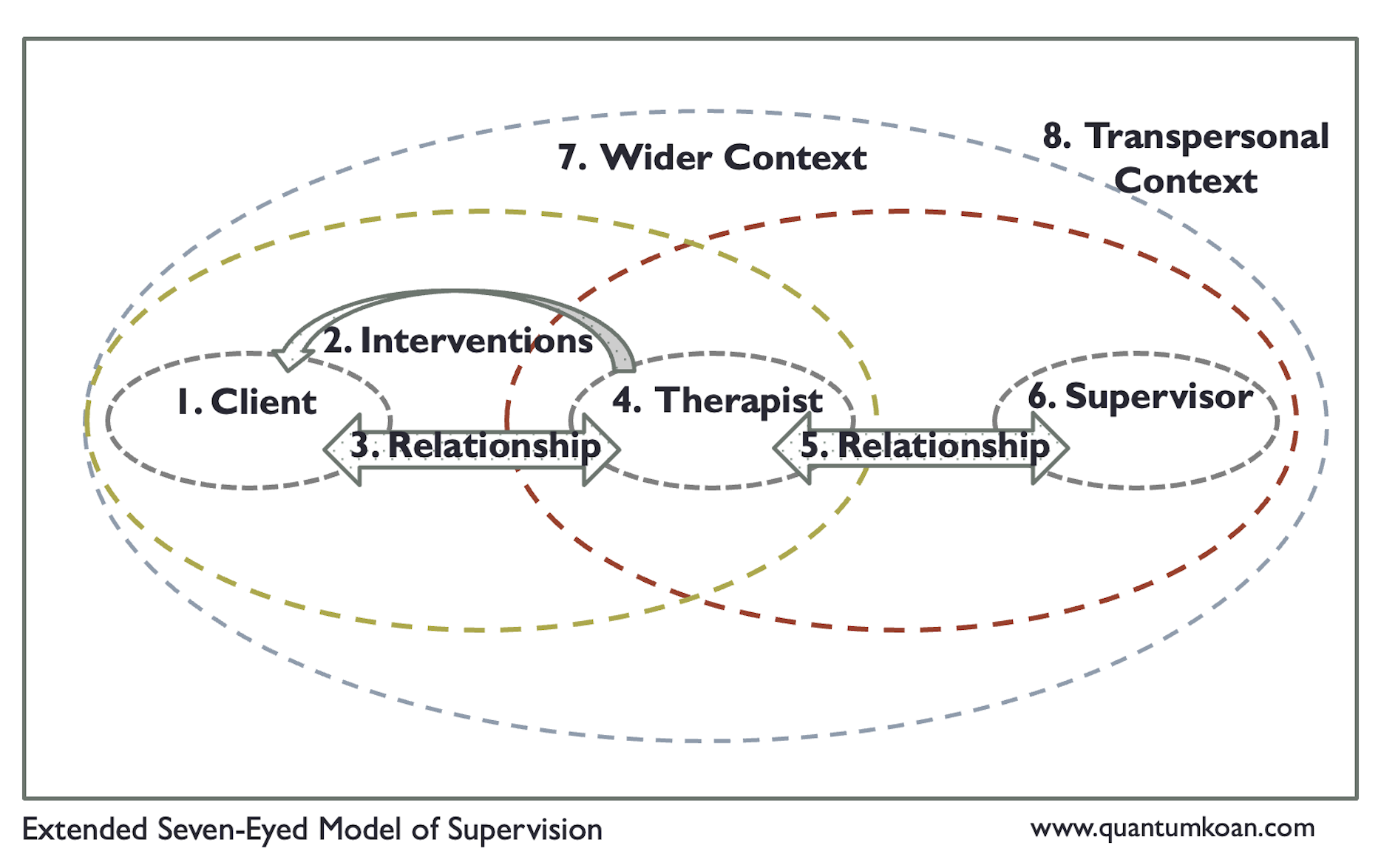
The Extended Seven-Eyed Model of Supervision, illustrating the relational, contextual, and transpersonal dimensions of therapeutic work.
The Seven Lenses of Supervision
The model can be explored through seven distinct perspectives, or “eyes,” each offering a different way of understanding the work.
Each perspective invites a shift in attention. As we move between them, we begin to see the therapeutic process from different angles, allowing the complexity of the work to be held more fully.
We begin with the client, and gradually widen the field of awareness.
1. Focus on the Client and How They Present
Attention first rests with the client, as they are in the moment.
We notice how they arrive, their physical presence, how they move, breathe, and speak, as well as the language, metaphors, and images that shape their experience.
We also attend to what they choose to bring, the areas they wish to explore, the choices they make, and the connections across different aspects of their lives.
2. Focus on Interventions
From here, attention begins to include how the therapist meets what is being brought.
We reflect on the therapist’s responses, the interventions and approaches they use, and the timing and intention that inform these choices.
This perspective opens space to consider alternative ways of responding, allowing new possibilities to emerge within the therapeutic process.
3. Focus on the Client–Therapist Relationship
Beyond individual responses, the focus expands to the relationship itself.
The therapeutic relationship is approached as a living process, shaped over time through contact, boundaries, and the development of the alliance.
We may notice how sessions begin and end, what happens at the edges, the images or metaphors that arise, and the presence of transference within the relationship.
4. Focus on the Therapist’s Process
As we stay with the relationship, attention also turns inward to the therapist’s experience within it.
This includes emotional responses, countertransference, and the ways in which the therapist is affected—both consciously and unconsciously—by the work.
It also invites reflection on the therapist’s ongoing development and how they sustain and resource themselves in practice.
5. Focus on the Therapist–Supervisor Relationship
The field then extends into supervision, where the therapist’s experience is held and explored within the supervisory relationship.
The quality of this alliance is central. It can support the therapist, deepen understanding, and, at times, illuminate patterns present in the therapeutic work.
6. The Supervisor’s Own Process
Within this relationship, the supervisor’s own experience becomes another source of awareness.
Feelings, thoughts, images, and bodily responses that arise while listening can offer valuable insight into what may be unfolding within the client–therapist relationship.
7. Focus on the Wider Context
The perspective widens further to include the broader context in which all of this takes place.
This includes the client’s family, social, cultural, and economic environment, as well as the therapist’s professional setting and the wider context in which both therapist and supervisor are situated.
Ethical and professional frameworks are also held here, supporting safe, grounded, and responsible practice.
Closing reflection
These perspectives do not stand apart, but form a living, interconnected field.
All are held within a transpersonal understanding—an openness to meaning and values, a recognition of our shared humanity, and a willingness to see difficulty as a possibility for growth.
Supervision moves fluidly between these different ways of seeing. While all are available, it is not necessary for each to be present in every session.
Reference
Hawkins and Shohet (2006). Supervision in the helping professions. Open University Press, McGraw-Hill Education